Wildlife & Birds
Hornbills of Nepal: Great Hornbill, Male and Female, and the Sealed Nest
Himal Shahi Thakuri · Oct 26, 2026 · 23 min read
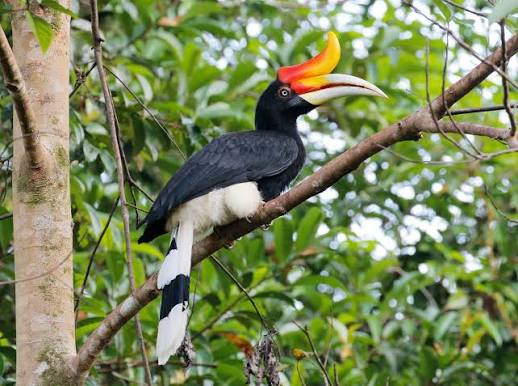
There is a sound in the lowland forests of eastern and central Nepal that people do not forget. It is the heavy, rhythmic beating of enormous wings, a noise that has been compared to a distant steam engine starting up. If you look up, you may see a black and white bird the size of a small goose, with a bill as long as your hand and a glowing yellow crown on top of it. That is a great hornbill, and seeing one in Nepal is a rare privilege.
Hornbills belong to a family of birds found across Africa and Asia. They are known for their massive curved bills, the hollow helmet-like structure called the casque on top of the bill, and one of the strangest family lives in the bird world. In most hornbill species, the female seals herself inside a tree cavity with mud and her own droppings and stays there for months, while the male feeds her through a narrow slit. It sounds like a fairy tale, but it is real, and it explains a lot about why hornbills are in trouble.
This article introduces the hornbills of Nepal, from the rare great hornbill to the small and noisy oriental pied hornbill and the grey hornbill of village avenues. It also tells the story of the rufous-necked hornbill, a species that was written off as lost from Nepal for almost 200 years and then photographed again in 2021. We will look at how to tell males from females, how the sealed nest works, why hornbills matter to the forest, and what threatens them. Sources are listed at the end.
What Is a Hornbill?
Hornbills are members of the family Bucerotidae. There are about 54 to 56 species in the world, depending on which authority you follow, and they live in tropical Africa and Asia. They range from small, mostly grey birds to giants like the great hornbill and the southern ground hornbill of Africa, which stands about a metre tall.
Several features make them easy to recognise. The bill is long, thick and usually curved downward. On top of it, most species carry a casque, a hollow structure that can be a small ridge or a huge horn-like helmet. The eyelashes are long and bristly, which gives the face a striking, slightly comical look. The bones are lightly built and pneumatised, with air spaces that reach right out to the wing tips, which helps them carry such a heavy bill.
In Nepali, hornbills are commonly known as dhanesh (धनेश), a word shared with other South Asian languages. Different regions may have their own names for particular species, so local names are worth collecting if you are writing for a local audience.
Hornbills are mostly fruit-eaters, but they are not strict vegetarians. Great hornbills eat figs and other fruit, and also take small mammals, birds, reptiles and insects. The oriental pied hornbill eats fruit such as figs, along with insects, small reptiles and frogs. Their diet makes them important seed dispersers, a role that will come up again later.
The Hornbills of Nepal
How many hornbill species does Nepal have? The answer is a little complicated. A Tribhuvan University study of the great hornbill in Chitwan National Park states that Nepal’s forests harbour three hornbill species, the great hornbill (Buceros bicornis), the oriental pied hornbill (Anthracoceros albirostris) and the Indian grey hornbill (Ocyceros birostris), and that all three occur in Chitwan National Park. It adds that a fourth species, the rufous-necked hornbill, had been considered locally extinct.
That changed in December 2021, when a wildlife photographer photographed a pair of rufous-necked hornbills in Ilam district. We will tell that story below. For now, the practical answer is that Nepal has three regularly recorded hornbills and one extremely rare fourth species that has only just been rediscovered.
These birds live in different habitats. The great hornbill needs tall, mature lowland forest, especially riverine forest. The oriental pied hornbill is a bird of forest edges and tall trees in the lowlands and foothills. The Indian grey hornbill is the most adaptable and can even live in towns with old avenue trees. All three are found mainly in the Terai and low foothills, mostly at low altitudes.
The Great Hornbill: Nepal’s Giant
The great hornbill, also called the great pied hornbill or concave-casqued hornbill, is the largest hornbill in Nepal and one of the biggest in the world. Bird Conservation Nepal describes it as 100 to 120 centimetres long with a wingspan of around 150 centimetres, or five feet. The body is mostly black, with a white neck, white wing coverts and white-tipped flight feathers and tail. The bill is large and yellow, and on top of it sits the casque, a yellow and black structure that gives the bird its dramatic profile.
In Nepal it is a rare and local resident at low altitudes, roughly 100 to 500 metres. Records from the government’s Department of National Parks and Wildlife Conservation list Chitwan National Park and its buffer zone, including Barandabhar forests and the Kumroj and Namuna community forests. They also list Bardia National Park, Parsa Wildlife Reserve, the Ghodaghodi lake area, forests in Kapilvastu and Sarlahi districts, the Jhapa and Ilam border area, Sunsari and Morang. BirdLife International’s species page adds the Mai Valley forests.
The population is small. The department gives an estimate of between 80 and 150 individuals in Nepal, although that figure comes from older surveys and should be read as a rough guide. Nepal’s national Bird Red Data Book categorises the great hornbill as Endangered, and the species is listed as Protected under the National Parks and Wildlife Conservation Act of 1973 and in Appendix I of CITES. In fact, it is one of only nine bird species named in the Act, alongside birds such as the danphe, the Bengal florican, the sarus crane and the black stork.
Globally, the species’ status has recently been revised. Older sources, including Nepal’s wildlife department, list it as Near Threatened on the IUCN Red List. BirdLife International’s current factsheet lists it as Vulnerable, with a global population estimated at 13,000 to 27,000 mature individuals and a decreasing trend. If you quote the status, check the current IUCN Red List entry first.
What a great hornbill does with that huge casque is still not fully understood. A museum summary notes that the purpose is unknown, but that males sometimes butt each other in mid-flight, so the casque may have evolved through sexual selection. In any case, it is the feature that makes the bird so recognisable and, unfortunately, so desirable to hunters.
The Oriental Pied Hornbill
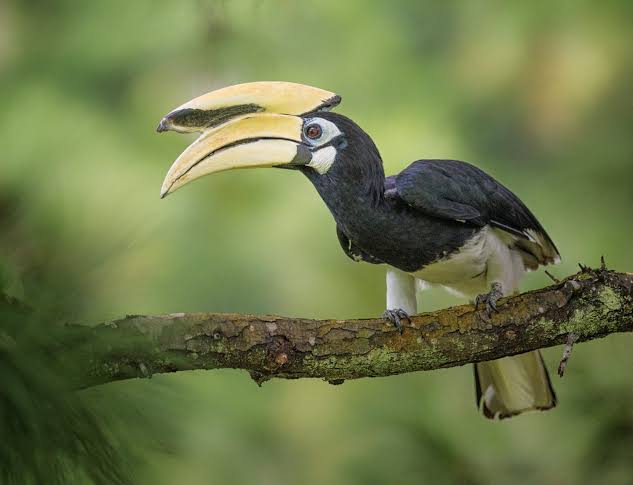
The oriental pied hornbill is smaller and much more widespread. It is considered one of the smallest and most common Asian hornbills, around 55 to 60 centimetres from head to tail, and it is listed as Least Concern by the IUCN. It has a black head, neck, back and upper breast with a slight green sheen, and a white belly and lower breast. The tail is black with white tips on most feathers. The bill is yellowish with a black base, and the casque is a flattened ridge that may protrude like a small horn.
Its call is quite different from the great hornbill’s. It has been described as crowlike, braying, or a harsh crackle and screech, and a group of them can be very noisy. They feed in the treetops, eating figs and other fruit, and they also take insects and small reptiles. Young birds look like adults but have an undeveloped casque and a smaller bill.
In Nepal, wildlife photographers have recorded the oriental pied hornbill in places such as Bansbari Community Forest in Mechinagar, Jhapa district, and the Tribhuvan University study lists it as occurring in Chitwan National Park. As a species, it breeds from about February in much of its range. It is also an important seed disperser, helping to spread the seeds of the fruits it eats.
The Indian Grey Hornbill
The Indian grey hornbill is the one most people are likely to see. It is a medium-sized bird, about 61 centimetres long, with grey plumage over most of the body, a pale grey or dull white belly, and a black or dark grey bill with a casque that runs along it. It is mostly found on the plains, below roughly 600 metres, in pairs. It is one of the few hornbills that can live in towns and cities, as long as they have big old trees, such as avenue trees along roads.
BirdLife International lists it in Nepal in places including Chitwan, Bardia, Parsa, Sukla Phanta and Koshi Tappu, as well as Barandabhar forests, Dharan forests and farmlands around Lumbini. A photographer has also recorded it in Kakarvitta in Jhapa district. Like the oriental pied, it is listed as Least Concern globally.
Its nesting season runs roughly from April to June, with a clutch of one to five white eggs. It nests in tree hollows on tall trees and may excavate an existing hollow further. It also has some entertaining social habits, including bill-grappling and aerial jousting.
The Rufous-Necked Hornbill: The Bird That Came Back
The rufous-necked hornbill (Aceros nipalensis) has one of the most remarkable stories among Nepal’s birds. It was first scientifically described from Nepal. In 1829, the naturalist Brian Houghton Hodgson described several birds that had been caught by hunters in sal forests in Nepal and gave the species the name nipalensis, meaning “of Nepal”.
After that, the bird disappeared from the record in Nepal for almost two centuries. Field guides, including the standard Guide to the Birds of Nepal, described it as probably extinct in the country. Conservationists pointed to hunting and habitat loss as likely causes. One analyst pointed to reports of some birds around 1850, but there were no confirmed modern records.
Then, on 21 December 2021, wildlife photographer Deven Kharel photographed a pair of male rufous-necked hornbills at Sim Dhap in Suryodaya Municipality, Ilam district, eastern Nepal. No one had photographed the bird in Nepal before. The sighting suggested that small numbers may have survived, or returned, in the eastern hills, and it showed how little systematic survey work had been done for the species.
Globally, the rufous-necked hornbill is listed as Vulnerable by the IUCN, although some authors have suggested downgrading it to Near Threatened as more information on its range has come in. It is the northernmost hornbill, ranging through mountain forests from eastern Nepal to Vietnam. It is a large bird, about 120 centimetres long. This is a species that has not been properly surveyed in Nepal, and any reliable record is valuable to researchers.
Male or Female? How to Tell Hornbills Apart
Telling male and female hornbills apart is easier in some species than in others. In many hornbills the sexes look similar at a glance, but there are consistent differences in size, eye colour, casque shape and sometimes plumage.
Great hornbill. The male is larger than the female. The most reliable field clue is the eye. A zoo and aviculture source notes that male great hornbills have red eyes with a black rim, while females have white eyes. The male’s casque is also typically larger and has two points at the front, while the female’s casque is smaller and less pointed. Weights given by one zoo fact sheet are about 5.5 to 7.75 pounds, roughly 2.5 to 3.5 kilograms, for males and 4.8 to 7.4 pounds, roughly 2.2 to 3.4 kilograms, for females, although there is a lot of overlap.
Oriental pied hornbill. Both sexes are similarly coloured, but the male is larger and has a bright red eye and a yellow bill with a black base. The female is smaller. In the field, you often see pairs together, and the larger bird with the more prominent bill is usually the male.
Indian grey hornbill. The sexes look alike, but the bare skin around the eye is dark in the male and sometimes pale reddish in the female. Juveniles lack the casque, and the skin around the eye is dull orange.
Rufous-necked hornbill. This is the one species in Nepal where the sexes look strikingly different. According to Banglapedia’s species notes, the male has a rufous neck and breast, while the female is almost entirely black except for white wing tips and the terminal half of the tail. The pair photographed in Ilam in 2021 were both males.
Be cautious with sexing from photos. Light, angle and age can all mislead, and young birds may not show adult features. The behaviour at the nest, which we turn to now, is often the most reliable guide.
The Sealed Nest: A Strange and Wonderful Family Life
If hornbills are famous for one thing, it is their nesting. In almost all species, the female enters a natural cavity in a large tree, seals the entrance with a plaster, and stays inside to lay eggs, incubate them and care for the chicks. Banglapedia notes that this behaviour is true for all but two of the world’s hornbill species.
Here is how it works in the great hornbill. The pair chooses a large natural cavity in a tall tree. Conservation groups describe how both birds work together to seal the female in. The male brings mud, and the plaster is mixed from mud, droppings and other material, leaving only a narrow vertical slit. The nest cavity can be 8 to 35 metres above the ground. The female typically lays one or two eggs, and the nesting season in Nepal is reported as roughly February to May, although other sources give January to April for the species across its range.
Once she is sealed in, the female depends entirely on her mate. The male collects fruit, insects and other food, and passes it through the slit. In the great hornbill, food is swallowed by the male and then regurgitated to the female, in other words delivered from his throat, not carried in the bill. The male may also supply wood shavings or bark pieces, which absorb waste and help keep the nest clean, and chicks and the female eject their droppings through the slit so that the nest stays hygienic.
While she is inside, the female goes through a full moult. Most hornbill females drop all their flight feathers within days of starting to lay, and the new feathers grow back before she leaves. The feathers may be used as nest lining. In large forest species the female can remain inside until the chick is ready to fledge, a total period of about four to five months.
The ending has a clever twist. After the chick has grown, the adults break open the seal so the female can leave. In the great hornbill, the chick then rebuilds the wall of the nest and stays safely inside alone, while both parents continue to feed it until it is fully fledged and ready to leave for good. For smaller hornbills such as the Indian grey, the female’s feather regrowth coincides with the maturity of the chicks, at which point the nest is broken open.
This system has a logic. A tree cavity sealed with a narrow slit is hard for snakes, monkeys, martens and other predators to enter. But it also means that the whole family depends on two things, a suitable tree and a mate who survives the entire season. Lose the male, and the female and chicks starve. Lose the nest tree, and there is nowhere to go.
Hornbills are generally monogamous, and pairs may return to the same nest site. In the great hornbill, males may defend an area of around 100 metres around the nest during the breeding season, according to the Chitwan study’s literature review.
Farmers of the Forest
Because hornbills eat fruit and fly long distances, they are some of the best seed dispersers in tropical forests. Conservation groups call the great hornbill one of the “farmers of the forest” for this reason. A bird that swallows a fig and then flies several kilometres before passing the seed helps trees colonise new areas, and the large seeds of some tree species may depend on big birds like hornbills to move them.
The Chitwan study gives a sense of what great hornbills eat in Nepal. Researchers found them feeding mostly on fruiting trees such as Dysoxylum binectariferum, banyan (Ficus benghalensis) and simal (Bombax ceiba), and fruits from the Myristicaceae and Lauraceae families were important in the diet. These are mostly large trees of mature forest, which tells you what kind of habitat the bird needs.
A related point is that hornbills need old trees. The great hornbill depends on tall, dense, unlogged forest in hilly regions, and conservation groups say that trees that rise above the canopy are preferred for nesting, with natural cavities large enough to hold a female and chicks. Such trees may take many decades to develop a cavity, and they cannot be replaced quickly.
What the Chitwan Study Found
One of the few detailed studies of great hornbills in Nepal was carried out in Chitwan National Park by researcher Arjun Khanal as a Tribhuvan University thesis. The survey covered 14 transects in five blocks of the park, in both sal forest and riverine forest, in winter (November) and summer (March). Hornbills were recorded on 11 of the 14 transects. They were found mostly in riverine forest rather than sal, and their distribution pattern was uniform. Hunting, habitat loss and human disturbance were identified as the major threats.
The study concluded that community-based conservation programmes should be encouraged and that more research on abundance and distribution is needed. That last point is important. Even for a legally protected, nationally endangered bird, systematic monitoring is thin. A recent review noted that the great hornbill is ecologically important and severely threatened but poorly studied and documented in Nepal, and that it is distributed in pockets in Chitwan, Bardia and Parsa, occasionally in Shuklaphanta, and patchily outside protected areas.
Threats: Why Nepal’s Hornbills Are in Trouble
The threats to hornbills in Nepal are a mix of habitat loss, hunting and disturbance, and they are linked to the birds’ special biology.
Loss of nest trees. A project on citizen science for hornbill conservation in eastern Nepal states that hornbill numbers have been declining rapidly over recent decades, with deforestation restricting them to a few regions and reducing the number of cavity trees they need. The project notes that the loss of nesting trees is contributing to a regional shift of hornbills from Nepal to India. Because hornbills nest only in tree cavities, they cannot simply move into other habitats.
Hunting. The same project names hunting for the beak, meat and oil as a main factor. Hornbill casques and feathers are used in some cultures for ornaments and ceremonies, and body parts are used in traditional medicine. BirdLife International lists subsistence use of the great hornbill for food and medicine as a threat. In north-east India, hunters have long targeted the related rufous-necked hornbill for feathers and beaks.
Logging and disturbance. Great hornbills depend on old-growth forest, and the removal of large trees is considered the biggest threat. Human disturbance near nests can cause failure, especially because the sealed nest system makes the family so dependent on undisturbed conditions.
A small, fragmented population. With Nepal’s great hornbill population estimated at under 200, even a few losses can matter. Populations in separate forest patches may be cut off from each other, which makes recovery harder.
Lack of data. For several species, including the rufous-necked hornbill, there is simply not enough information to know how many birds remain or where they are. Without surveys, protecting them is difficult.
Law and Protection
The great hornbill is one of the nine bird species protected under Nepal’s National Parks and Wildlife Conservation Act of 1973, and its listing under CITES Appendix I bans international commercial trade. Hunting, trapping or trading the bird or its parts is illegal. I did not retrieve the current penalties, so check the latest text of the Act or a legal source if you need exact fines and sentences.
An important point raised by Nepali ornithologists is that the protected bird list is old. A review by Hem Sagar Baral noted that the list was drawn up several years ago and needs to be updated to reflect what is now known about Nepal’s birds, and that a revised list was being recommended to the government. In practice, that means that other hornbill species and other threatened birds may not have the same legal protection as the great hornbill, even if they face real pressure.
What Is Being Done
Conservation of hornbills in Nepal is still at an early stage compared with tigers and rhinos, but there are encouraging efforts.
Community and citizen science. The eastern Terai project mentioned above aims to involve young people from local communities in erecting artificial nest cavities, collecting data and protecting habitat. Artificial nest boxes have helped hornbills in other countries, though they need careful design and monitoring.
Lessons from India. In Arunachal Pradesh, the Wildlife Trust of India, the state forest department and citizens have run a Hornbill Nest Adoption Programme, which pays local people to protect nests, and have promoted fibreglass replicas of hornbill beaks to replace real ones in traditional dress. These approaches could inform Nepal’s work, although each community’s culture and economy is different.
Protected areas. Chitwan, Bardia and Parsa remain the most important strongholds for the great hornbill, along with the buffer zone forests and community forests that surround them. Keeping riverine forest and large fig and simal trees standing is one of the most direct ways to help.
Research. The 2021 rediscovery of the rufous-necked hornbill has drawn attention to eastern Nepal’s hill forests. Systematic surveys there could reveal how many birds are present and what they need.
Watching Hornbills Responsibly
If you want to see hornbills in Nepal, your best chances are in the Terai. For great hornbills, try Chitwan National Park and its buffer zone, Barandabhar forests, Bardia and Parsa, and hope for a bit of luck, since the species is rare. For oriental pied and Indian grey hornbills, forest edges and tall trees in Chitwan, Jhapa and the eastern Terai are good places to start. Fruiting fig trees are the best places to wait, because hornbills gather to feed.
Go with a local nature guide whenever possible. They know which trees are fruiting and where birds have been seen, and your fee supports local livelihoods. Early morning is best, when the birds are most active.
Keep your distance. Never approach a nest, climb a nest tree or tap the trunk to see what happens. A disturbed female may be unable to escape, and a frightened male may stop bringing food. Avoid playing recorded calls near nests, which can stress birds during the breeding season. Do not share the exact location of a nest online, because that can attract disturbance or poachers.
If you photograph a hornbill, note the date, place, number of birds and whether you saw a male, a female or a pair, and upload it to a citizen science platform such as eBird or iNaturalist. Good records are exactly what Nepal’s hornbill science lacks.
Do not buy souvenirs made from hornbill casques, beaks or feathers. If you are offered one, you can assume it is illegal, and reporting it to the authorities helps protect the species.
Common Questions
Are there hornbills in Nepal? Yes. The great hornbill, oriental pied hornbill and Indian grey hornbill are found in the lowlands, and the rufous-necked hornbill was rediscovered in eastern Nepal in 2021.
How can you tell a male hornbill from a female? In the great hornbill, males have red eyes and females white eyes, and males are larger with a bigger casque. In the oriental pied hornbill, males are larger with a red eye. In the rufous-necked hornbill, males have a rufous neck and breast while females are mostly black.
Why does the female hornbill seal herself in a tree? It protects her, her eggs and her chicks from predators such as snakes and monkeys. She stays inside for months while the male feeds her through a slit.
Do hornbills mate for life? Hornbills are generally described as monogamous, and pairs often stay together and may reuse nest sites, but I did not find studies of lifelong pair bonds in Nepal’s species.
What is the casque for? Nobody knows for certain. In the great hornbill, males sometimes butt each other in flight, so it may be involved in display or competition.
How long do hornbills live? Great hornbills have lived up to about 40 to 50 years in captivity. Wild lifespans are less well known.
Is the great hornbill endangered? In Nepal it is listed as Endangered in the national Red Data Book. Globally it is currently classed as Vulnerable by BirdLife International, though older sources say Near Threatened.
Closing Thoughts
Hornbills are the kind of birds that make a forest feel ancient. Their size, their sound and their sealed nests all speak of a life built around big trees and long seasons. In Nepal they live at the very edge of their range, in a few small pockets of lowland forest, and they are still hanging on.
What makes the story hopeful is the rufous-necked hornbill. A bird that was thought lost for almost two centuries turned up again in an Ilam forest, a reminder that Nepal’s wildlife still has surprises and that absence of records is not always absence of birds. What makes it urgent is the arithmetic of the great hornbill: perhaps 80 to 150 birds, tied to a handful of old trees, each nest dependent on one male and one sealed cavity.
Protecting hornbills means protecting big old trees, fig-rich riverine forest and the quiet that nesting birds need. It also means paying attention. The next time you hear the whoosh of heavy wings over a Terai forest, look up. You may be seeing one of the rarest birds in Nepal.
Sources and Further Reading
This article draws on the Department of National Parks and Wildlife Conservation’s species page for the great hornbill, BirdLife International species factsheets for the great hornbill and Indian grey hornbill, Bird Conservation Nepal’s great hornbill profile, a Tribhuvan University thesis by Arjun Khanal on great hornbills in Chitwan National Park, Hem Sagar Baral’s review of Nepal’s protected birds, Global Voices and Ask Me About Nepal reporting on the rufous-necked hornbill’s return, the Wikipedia articles on the rufous-necked hornbill, oriental pied hornbill and Indian grey hornbill, Banglapedia’s entry on hornbills, a Rufford Foundation project on citizen science for hornbill conservation in eastern Nepal, World Land Trust and San Francisco Zoo fact sheets on the great hornbill, Museums Victoria’s specimen summary, the Wildlife Friends Foundation’s profile of the oriental pied hornbill, and aviculture literature on great and black hornbills. Please verify details against the original sources before relying on them, especially conservation status and legal provisions, which change over time.